
Showing posts with label Legislative Assembly Building. Show all posts
Showing posts with label Legislative Assembly Building. Show all posts
Wednesday, November 23, 2011
Songhees Point at Night

Friday, August 26, 2011
A Closer Look 9 - Sir Matthew Baillie Begbie
 Matthew Baillie Begbie (later Sir Matthew) was sworn in as Chief Justice at the same time (1858) as James Douglas was sworn in as governor of the Colony of British Columbia for the same reason - to establish British sovereignty and rule of law in the colony, especially in the previously lawless area of the Cariboo Gold Rush. Baillie was very much a renaissance man. In addition to his work as a judge, he drafted laws and had numerous other activities. He was an avid naturalist and opera singer and spoke several of the languages of the Native Peoples well enough to conduct trials in them without the use of an interpreter. He was popular and respected and must have been a very interesting man. You can find out more about him by clicking HERE and HERE.
Thursday, August 25, 2011
A Closer Look 8 - Sir James Douglas, KCB
 Canada's main transcontinental highway is Highway Number 1 and Mile Zero on that highway is here in Victoria. Those of us who live here, however, don't think of it as Highway Number 1 but as Douglas Street, Victoria's main thoroughfare. It's named after Sir James Douglas, KCB, whose photo is above. The original hangs in a hall in the BC Legislative Assembly Buildings along with photos of other important political figures. Sir James, often referred to as the "Father of British Columbia" because of his decisive actions during the 1857 gold rush, was also the founder of Fort Victoria (1843), which has grown into the modern city. A summary of Sir James' actions during the Cariboo Gold Rush can be read by clicking HERE. Sir James' background provides a lot of food for thought. While we often think of the colonial administration here as John Bull British, it is good to remember that Douglas was born in Guyana, of a Scottish father and a creole mother, a person of mixed European and African ancestry. Sir James' wife was part Cree so there were many cultural factors both in his early and later life. Earlier in this series I posted a photo of Sir James' statue in its niche on the exterior of the BC Legislative Assembly Buildings, along with a photo of Judge Begbie's statue. I suspect both statues were made in the likeness of photos that are hanging in the halls of the legislature. Tomorrow we'll have a closer look at Judge Begbie.
 Tuesday, August 23, 2011
A Closer Look 7 - Murals in the Rotunda
 |  |
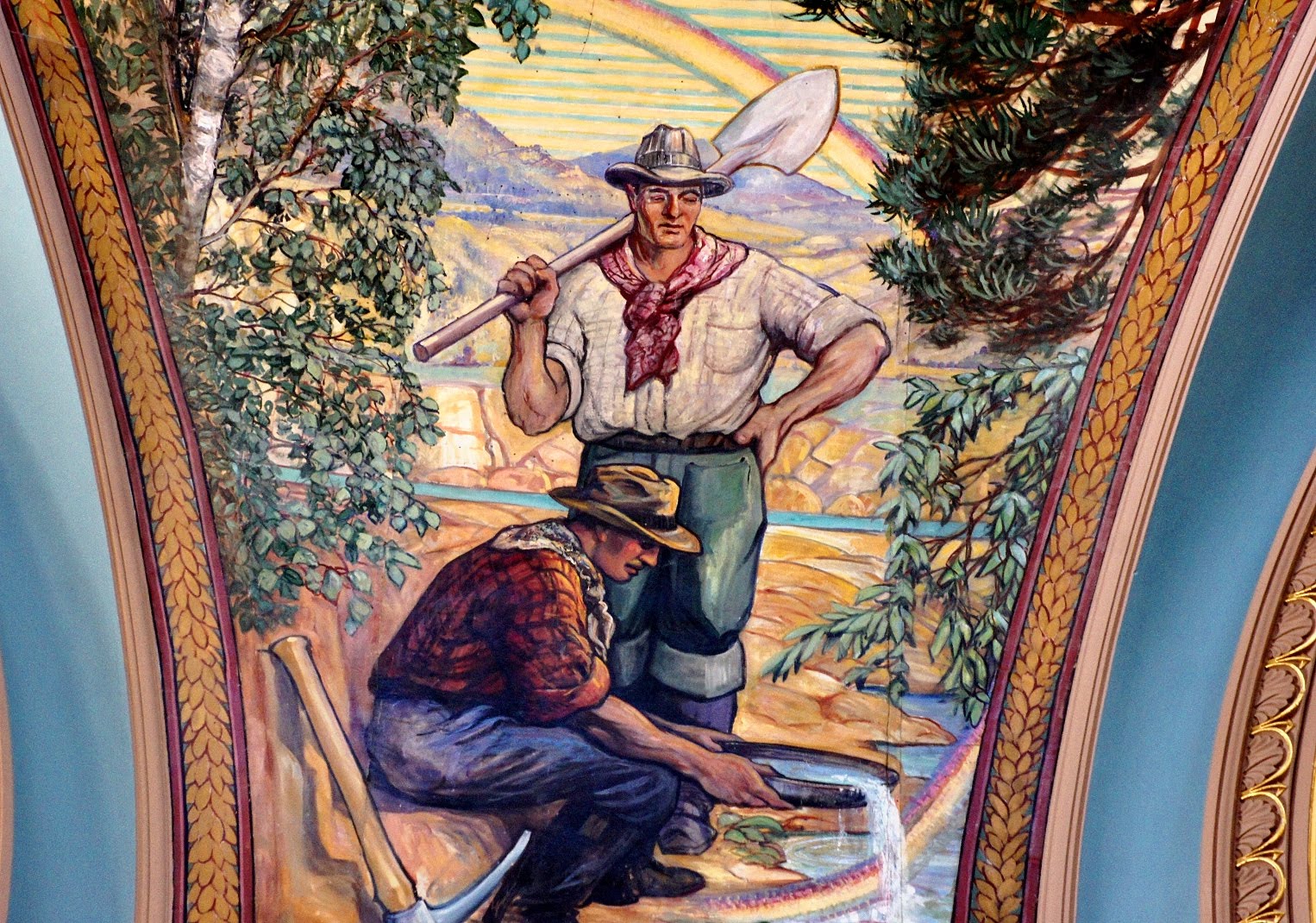 |  |
Sunday, August 21, 2011
A Closer Look 6 - Chamber and Coat of Arms

 | Continuing with our closer look at the British Columbia Legislative Assembly Buildings, above is a photo of the chamber where the provincial legislators meet to govern the province. At the far end is the Speaker's chair. The photo on the left is the official British Columbia Coat of Arms on one wall of the ground floor of the rotunda. This coat of arms has had a long and somewhat controversial history which you can read about by clicking HERE. |
Thursday, August 18, 2011
A Closer Look 5 - Inside the Legislative Assembly Building
 Striking as it is from the outside, the interior of the Legislative Assembly Building is equally interesting. Here we are looking upward inside the rotunda at the entrance the the building.
 Friday, August 12, 2011
A Closer Look 4

| Earlier this week I posted photos of Sir James Douglas and Sir Matthew Baillie Begbie, whose niches flank the main entrance to the Legislative Assembly Buildings. However, the highest place of honour, the topmost peak of the central dome is occupied by a gold covered statue of Captain George Vancouver. As well as being an early explorer and surveyor of this coast he settled the Nootka Sound crisis which established British control over this area. These photos were taken with a 500mm super-telephoto lens. I prefer the profile photo to the right except that it seems to draw attention to the Captain's rather outstanding...er...nose. |  |
Tuesday, August 9, 2011
A Closer Look 3
 After watching me lying on the stairs and leaning up against the corners of the building for a while one of the security guards laughed when I said I was trying to get a new angle on Victoria's Legislative Assembly Building. We agreed that if the building had lost one atom for each photograph taken, it would have disappeared long ago. I can't say I feel I succeeded with this shot of the main entrance but you can see two more of British Columbia's historically important figures in their niches and below.
| On the right is Sir James Douglas, often called "The Father of British Columbia," since he was the founder of Victoria and the first Governor of the colony of British Columbia. You can read all about him in Wikipedia. Douglas founded Fort Victoria in his capacity as Factor of the Hudson Bay Company. He became Governor of the expanded colony of British Columbia when it was in danger of becoming part of the USA due to its popularity arising from the discovery of gold. |  |
 | To the left is Sir Matthew Baillie Begbie, The first Judge of the Supreme Court of the Colony of British Columbia. Begbie traveled throughout the colony on horseback, dispensing justice where it was needed and upholding the laws during the tumultuous gold rush days. |
Thursday, July 28, 2011
A Closer Look II
 Continuing the series of photos looking at some of the details of the BC Provincial Legislative Assembly Buildings, above is another view of the portico of the Legislative Library at the rear of Legislature. And below are two more of the historical figures who stand in elevated niches on various corners of the building.
 | To the left is Chief Maquinna, identified on the plaque as "The Nootka Chief who welcomed the first white man landing on Vancouver Island in 1778." The First Nations people now occupying this area (Nootka Sound) are now more properly called the Nuu-chah-nulth. The white man in question was Captain James Cook although there is some doubt as to whether Cook and Maquinna actually met. Maquinna was later a central figure in events that are known as the Nootka Crisis when England and Spain went head to head in this area and Captain George Vancouver and Juan Francisco de la Bodega y Quadra sat down to sort it out. Captain Vancouver's statue now adorns the very top of the Legislative Assembly. A bust of Quadra can be seen in Quadra Park on Belleville Street, overlooking the Victoria's Inner Harbour. |
| To the right is Sir Francis Drake. According to the plaque, "British Activity in North Pacific began with his voyage in 1579." Drake is probably better known for his circumnavigation of the globe - only the second time this had been done - and for his many other naval exploits and conquests. Drake is not perhaps quite so politically correct these days since among his many activities he was a pioneer in the slave trade. It is only fair to note though that Chief Maquinna was also a slave owner. |  |
Thursday, July 21, 2011
A Closer Look
 Causeway Artist Dean Lewis suggested to me some time ago that I take a closer look at the Legislative Assembly Buildings that form so prominent a part of the scenery of the core of Victoria. So today begins a series I'll add to from time to time that will look at some of the details of these splendid buildings. At the rear of the legislature is a structure that is often ignored by visitors to the city, the Legislative Library, pictured above. It is adorned by numerous statues of important historical figures set in niches and plaques of low relief. Below are two.
 | On the top right corner of the above photo you can see the statue of one of my favorite people from our early history, Dr. John Sebastian Helmcken. Long ago when I was a grad student I had occasion to spend one summer reading all the issues of the Victoria Colonist Newspaper up to about 1900. While there were many colorful characters, the one whose remarks always made me want to meet him in person was Dr. John. His kindness and tolerance often seem out of step with his contemporaries and I am sure he made this province a better place than it would otherwise have been. |
| In addition to figures important to our particular history, the library also bears a number of reliefs of important literary and philosophical figures. In today's top photo, below and to the left of Dr. John is the relief on the right. This somewhat sour looking personage is the poet Dante Alighieri. |  |
Friday, July 1, 2011
Canada Day
 Today's photo is where our local Canada Day celebrations will center, Victoria's Inner Harbour. If you can imagine this scene with about 40,000 additional people you will have a pretty good idea of what it will be like later today. Happy Canada Day!
Thursday, September 9, 2010
Inner Harbour Causeway
 Here is what is probably Victoria's most photographed view, not surprisingly since it is an attractive vista. The three most prominent buildings, despite their different styles and purposes, were all designed by Francis Rattenbury. The three are the Fairmont Empress Hotel (on the left), the Legislative Assembly Buildings (slightly right of center) and the quite Grecian-looking Royal London Wax Museum (right). The first two are still used for their original purposes. The wax museum was originally designed for use as a steamship terminal. In the midst of these striking buildings, the Inner Harbour Causeway offers a colorful pedestrian walkway with musicians and artists, craftspeople and jugglers providing entertainment to the tens of thousands of visitors and locals who enjoy it every summer. This reads like a Tourism Victoria blurb but there's no denying it's a friendly, beautiful and interesting place.
Thursday, July 15, 2010
Dawn
 Taken just at sunrise last week, Captain Vancouver atop the green dome of the Legislative Assembly Buildings catches the first rays of the morning sun while the Port Angeles ferry, the MV Coho, awaits her morning departure.
Tuesday, July 6, 2010
Freakish Weather
 Those of you who visit here on a daily basis will remember that I said I was going out to Saanich yesterday to pick strawberries. Morning dawned wintry gray and wet, not a day for picking strawberries. Yet by mid-afternoon the the clouds had blown away and here's what it looked like downtown on the lawns of the BC Legislature. According to the weather prognosticators summer has finally arrived here (we've had weeks of cold cloudy days). It looks like a real summer day outside this morning so check here for strawberries tomorrow.
Friday, January 2, 2009
Christmas Lights
 Before I say goodbye to 2008 I wanted to doff my hat to the season, so here's a shot of the Inner Harbour with the Legislative Assembly Buildings in their Christmas colors. Please excuse the fuzziness - this is a hand-held time exposure. My fingers just get too numb if I try to mess with a tripod in this cold weather. As for the strange red lights in the sky, I think they must be reflections of tail-lights of cars passing (off camera below on the roadway).
Friday, November 21, 2008
Winter Light II
 A touch of the flu has kept me home today so here's another photo from yesterday, just after I left Chinatown. It's the Inner Harbor taken from the Johnson Street Bridge. I like the way the masts of the sailboats catch the winter sunset. (This is shortly after four o'clock in the afternoon.)
Thursday, October 30, 2008
Birds in Bronze
 In a photograph of the Legislative Assembly Building I posted in September there is a fountain in the foreground. Around the outer rim of this fountain are sculptures of four animals important in the mythologies of the native peoples of British Columbia. Above is a raven. Below is an eagle. There are also small sculptures of a bear and a wolf and, in the center of this fountain a few stone sea otters.
Saturday, September 6, 2008
Reference Subject
 Above is a subject I photograph almost every week so it seemed like a good reference subject for me to try out a new photo-processing technique. For those of you who don't recognize it, the above is an example of an HDR or High Dynamic Range image. The above is actually faux HDR since it is extracted from one RAW image rather than several images. However the effect is the very nearly the same. Below is the same image as it came from the camera without the HDR processing. Click on these to look at the large versions for comparison.
Tuesday, September 2, 2008
Bilateral Symmetry
 I suspect the reason we love bilateral symmetry is because we are made that way ourselves, as is most of the animal kingdom. In a larger sense, we love patterns, repetitions of sounds or shapes or colors, perhaps because we always hope that in the apparent chaos of reality is an underlying order, a unifying principle, a reason for the unfolding of the universe and for ourselves. Whatever the reason, bilateral symmetry is pleasing to the eye. The example above is the British Columbia Legislative Assembly Building from behind, rather than the more usual view from the front. And here's an interesting article on bilateral symmetry.
Friday, August 15, 2008
Protest
Victoria's Inner Harbor is a great place to stroll and take in the sights but it has its more serious side as well. Across the street from the causeway the Legislative Assembly Buildings lawn is often the scene of political demonstrations and protests. Most often these are meant to draw the public's and legislators' attention to problems or injustices within our own system. However, sometimes the protests are meant to draw attention to injustice in other countries. These demonstrators make the point that by allowing the Olympics to be held in Beijing, the IOC implicitly legitimizes China's oppression of Tibet.
 These demonstrators make the point that by allowing the Olympics to be held in Beijing, the IOC implicitly legitimizes China's oppression of Tibet.
Subscribe to:
Posts (Atom)